Article: Strengthening One State’s Legislative Decisionmaking Ecosystem

This year, the Southwest Comprehensive Center (Southwest CC) is partnering with New Mexico to strengthen one of the most consequential parts of its education system: the legislative decisionmaking ecosystem that shapes statewide policy, funding, and program design. Supported by Southwest CC’s analytic technical assistance (analytic TA) initiative, Southwest CC is building agency-wide analytic capacity inside the Legislative Education Study Committee (LESC)—the body lawmakers rely on for evidence-based guidance.
History shows that when governments base decisions on accurate, timely, and meaningful data-driven insights, public outcomes can transform. New York’s CompStat system used crime data to identify hotspots and deploy resources strategically, contributing to significant crime reductions. Tennessee’s Value-Added Assessment System (TVAAS) used longitudinal student data to identify effective teaching practices and target professional development, improving student outcomes and enabling more efficient use of state education funds.
New Mexico has been pursuing a similar leap forward, with the LESC playing a prominent role. To optimize decisions made on behalf of its students and communities, LESC staff are working to improve how LESC analysts interpret and translate the data and evidence lawmakers use to make decisions about schools, funding, and education policy.
This work is especially critical in New Mexico, which operates a citizen legislature—a system in which lawmakers serve part-time and often hold full-time jobs to stay closely connected to everyday life and the communities they represent. Because legislators have limited time and capacity, they rely heavily on professional support agencies like LESC to supply analysis, research, and policy guidance. Strengthening LESC staff’s analytic capacity strengthens the entire legislative ecosystem.
Building an Evergreen Engine for Evidence-Driven Policy
To meet this need, LESC staff partnered with Southwest CC in early 2026 to create an evergreen engine that strengthens and maintains, regardless of staff turnover, the agency’s ability to think critically with data, generate trustworthy insights, and use evidence to make better policy and program decisions.
Introducing the CREW Project: A Structured, Multimonth Capacity-Building Effort
Southwest CC’s support for LESC analysts has grown into what Southwest CC project co-lead Ryoko Yamaguchi, PhD, calls the “Capacity-building Research & Evaluation Workflow” (CREW) project. CREW is a structured, months-long effort that includes three components:
1. Individual coaching provided by Southwest CC for each analyst
Analysts receive one-on-one sessions focused on real projects, data methods, and confidence building.
2. Monthly Southwest CC-facilitated learning sessions as a Community of Practice
Analysts participate in one-hour sessions that walk through the full data workflow—from data collection through preparation and analysis.
3. Practical tools and resources
Southwest CC is creating reference sheets, templates, flowcharts, and other materials analysts can use daily and continue to iterate upon.
The partnership has resulted in a full set of slides, recordings, transcripts, templates, and surveys to support LESC’s continued action.
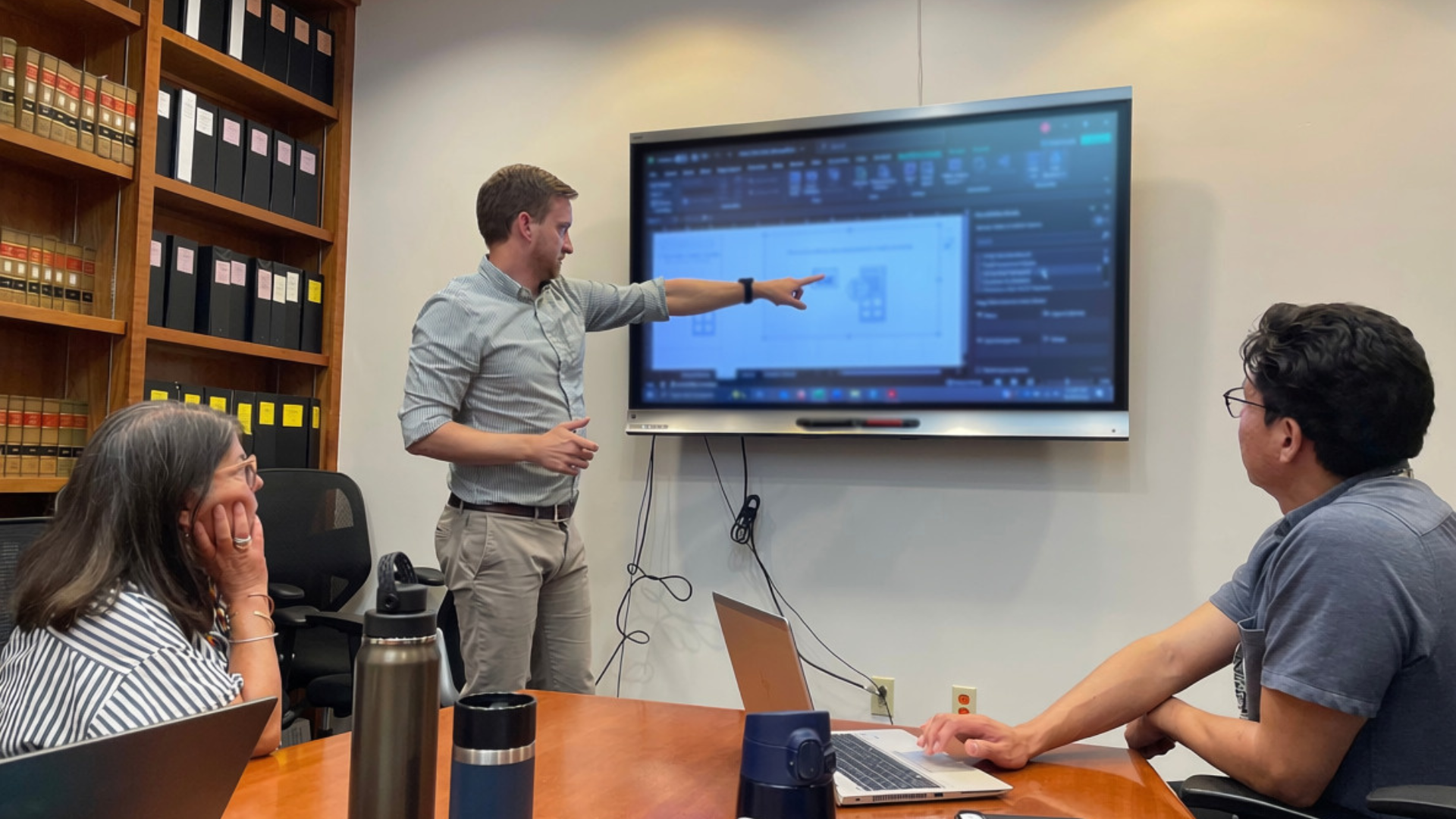
LESC policy analysts learn and improve their data and analytic skills through hands-on analytic technical assistance.
We are so fortunate to partner with the Comprehensive Center. I’m not sure we would have been able to get this type of one-on-one technical assistance anywhere else. It’s meant our analysts feel empowered to connect data to practice and policy.

What CREW Opens Up for New Mexicans
This investment—at no cost to the state, as Comprehensive Centers are federally funded—helps New Mexico build resilience to withstand political and internal staffing changes, producing a durable, agency-wide data system inside LESC’s staff operations. For example, LESC analysts will share common structures for onboarding, standardized workflows for daily practice, and clear off-boarding procedures so knowledge is not lost when staff transition.
Stronger data capacity leads directly to stronger policy decisions. Legislators depend on LESC for accurate, timely, meaningful evidence. When analysts have consistent workflows and deeper skills, lawmakers receive clearer information—allowing state agencies, districts, schools, and families to make better choices for students. With stronger evidence, policymakers can design better programs, target resources more precisely, and respond quickly to emerging needs
Shared data stewardship practices also protect the state during staff turnover. Analysts using common templates and processes—especially when collaborating with the state’s Public Education Department and other partners—can enable more coherent statewide decisionmaking.
Long-Term Benefit to Families, Schools, and the State
Southwest CC project co-leads Herz and Yamaguchi predict that over time this work will cascade in several ways that serve New Mexicans taxpayers, families, schools, and communities:
- Resource allocation aligned to real needs
- Policies that avoid unintended consequences
- Access paired with the supports students actually require
- Stronger systems thinking and upstream problem solving
As Yamaguchi puts it, the long-term goal is “ensuring every student has the mechanism to thrive.”
Early Breakthroughs Emerging
Early signs of impact are arising. After one Community of Practice session this summer, Yamaguchi reports that one LESC analyst noticed certain data was likely missing.
“We walked through how to approach differently, and he began to think about how we were, in this case, measuring ‘English Learners.’ That is, to second guess the data.”
Yamaguchi walked the analyst through a missing-data analysis. He then launched rethinking units of observation, missing data, and English Learner classification—demonstrating what Yamaguchi calls “deeper data stewardship.”
LESC intends to share such CREW learnings with the educators, advocates, and higher education faculty who serve on the English Learner work group to gather their input and inform statewide decisionmakers.
As Herz notes, “Data can help take some of the charge out of the air where there might be strong opinions—so groups can dig into ‘what do we know’ and ‘don’t we know’… and then get on the same page.”
Analysts Working Across the State’s Priority Areas
LESC analysts participating in CREW are supporting major state-identified priorities including, among others:
- AI regulation
- Arts/PE/library access
- Assessment streamlining
- Bilingual Education
- School infrastructure funding
- Career and Technical Education funding reform
- Distance learning oversight
- Educator career pathways
“You can see how ‘analytic TA’ becomes not just a project,” Herz notes, “but a long-term investment in the state’s capacity to make better decisions for students.”
On CREW’s evaluation survey, all participants agreed, or strongly agreed, that as a result of their CREW participation, they developed:
- A better understanding of how to collect, prepare, and analyze data to answer policy questions, and
- Greater capacity to use data to inform decisions about policies or practices in work with the legislature.
“Ryoko and Mitch were so patient and supportive throughout the process,” reports CREW participant Conor Hicks. “They both helped me gain confidence in organizing data and using it to tell a compelling story.”
Fellow CREW participant Sarai Ortiz agrees. “It was helpful to have CREW TA as a critical thought partner. Each session helped me think critically about my strategy and overarching goal.”
Learn more about CREW—read our Q&A with project co-leads Herz and Yamaguchi here.