Article: How Are States Reimagining Support Models to Meet the Real Needs of School Districts?

Across the Southwest, state educational agencies are centering their work around three core questions that are reshaping how they serve the field:
Who needs support? What support do they need? And what outcomes are those supports producing?
As states confront chronic absenteeism, school improvement demands, teacher shortages, and rising expectations for high-quality instruction, many are taking a hard look at the systems built over decades to support districts. The goal: make sure those systems actually work for the people on the frontlines.
Districts are stretched. States know it. And across the region, agencies are moving quickly to streamline internal processes, reduce administrative burden, and ensure that every support they offer is locally useful and aligned to what district leaders say they need most.
The Southwest Comprehensive Center (Southwest CC) is helping states accelerate this shift—strengthening state–local educational agency support models, building district-to-district peer networks, and grounding state services in real-time district feedback. The mission is straightforward: get districts exactly what they need to help students thrive.
Across Southwest CC’s newest District Supports projects, clear themes are emerging about what modern, high-functioning state agencies look like.
“We’re seeing a real shift in how agencies serve the frontlines,” says Liz Norton, Southwest CC’s District Supports portfolio lead and former Tennessee Department of Education Executive Director of Academic Strategy. “States are co-designing supports with district leaders, streamlining data systems to understand where evidence-based practices are taking hold, and connecting districts with each other to learn and grow.”
Southwest CC is helping states operationalize this evolution. Here are examples of what that looks like across the region.
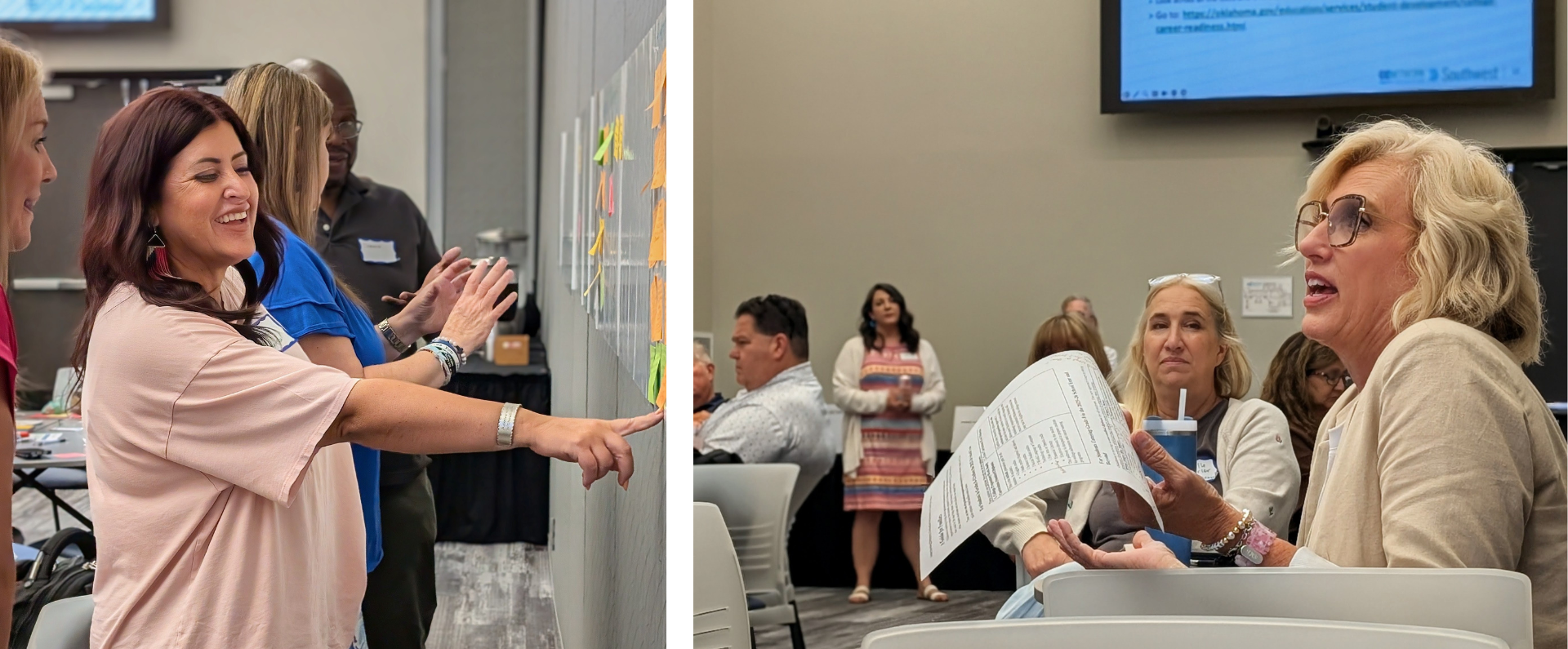
Left: Oklahoma school and district staff review and discuss brainstorming notes posted on a wall during a collaborative planning activity. Right: Oklahoma school and district staff participate in a feedback session on draft state guidance related to new education legislation.
Oklahoma: Reimagining School Improvement Through Superintendent-Led Learning
Superintendents in Oklahoma—like district leaders nationwide—want coherent, practical supports that help them solve real problems faster than they could on their own. That is why in the fall of 2026 the Oklahoma State Department of Education (OSDE), in partnership with Southwest CC, expects to launch Networked Improvement Communities (NICs) that have been directly shaped by superintendents, for superintendents.
Among other things, the NICs are designed to create space for leaders to access and interpret data more effectively, conduct root-cause analyses, use evidence-based tools, and learn from peers facing similar challenges.
Superintendents have a heavy lift. They must administer a combination of strategies that at once reduces chronic absenteeism, strengthens school improvement, and accelerates academic progress—often across schools with very different needs. Ensuring that the NICs are co-designed alongside superintendents is one important way the state is helping shoulder that lift in a way that truly meets the demands of the superintendent role.
New Mexico: Scaling High-Quality Instruction Statewide
Southwest CC is also supporting the New Mexico Public Education Department as it expands training, driven by recent legislation, to consistently enable state managers to conduct classroom walkthroughs that are aligned to high-quality instructional materials.
“With this critically important training, department staff will be positioned to produce the foundational statewide instructional data learnings that New Mexico’s schools and districts need,” says Norton.
Following the training, later this year, the state expects to generate new instructional data that will facilitate the design of strategies and supports that empower districts and schools to make strategic shifts at scale.
“With a clear view of instructional strengths and needs, the state can help districts build multilayered instructional support systems and drive professional learning from a place of real evidence—not assumptions,” adds Norton.
States Operationalizing Chronic Absenteeism Solutions
Some states have long set expectations for how schools should address chronic absenteeism. The challenge today in scaling this work is both technical and adaptive: What tools should states provide to districts working to track attendance and actively implement—and continuously improve—strategies proven to reduce chronic absenteeism?
With Southwest CC’s support, states in the region are operationalizing existing attendance frameworks so districts and schools can quickly make the decisions they need to keep more students in school and learning. For example, Southwest CC is currently working on an Absenteeism Intervention Implementation tracker that helps districts:
-
Translate research on chronic absenteeism into clear, actionable expectations
-
Monitor whether schools are using strategies that work
-
Move from tracking the data to using the data to drive action
The objective: arm local leaders with tools to turn data into decisions and decisions into improved student attendance.
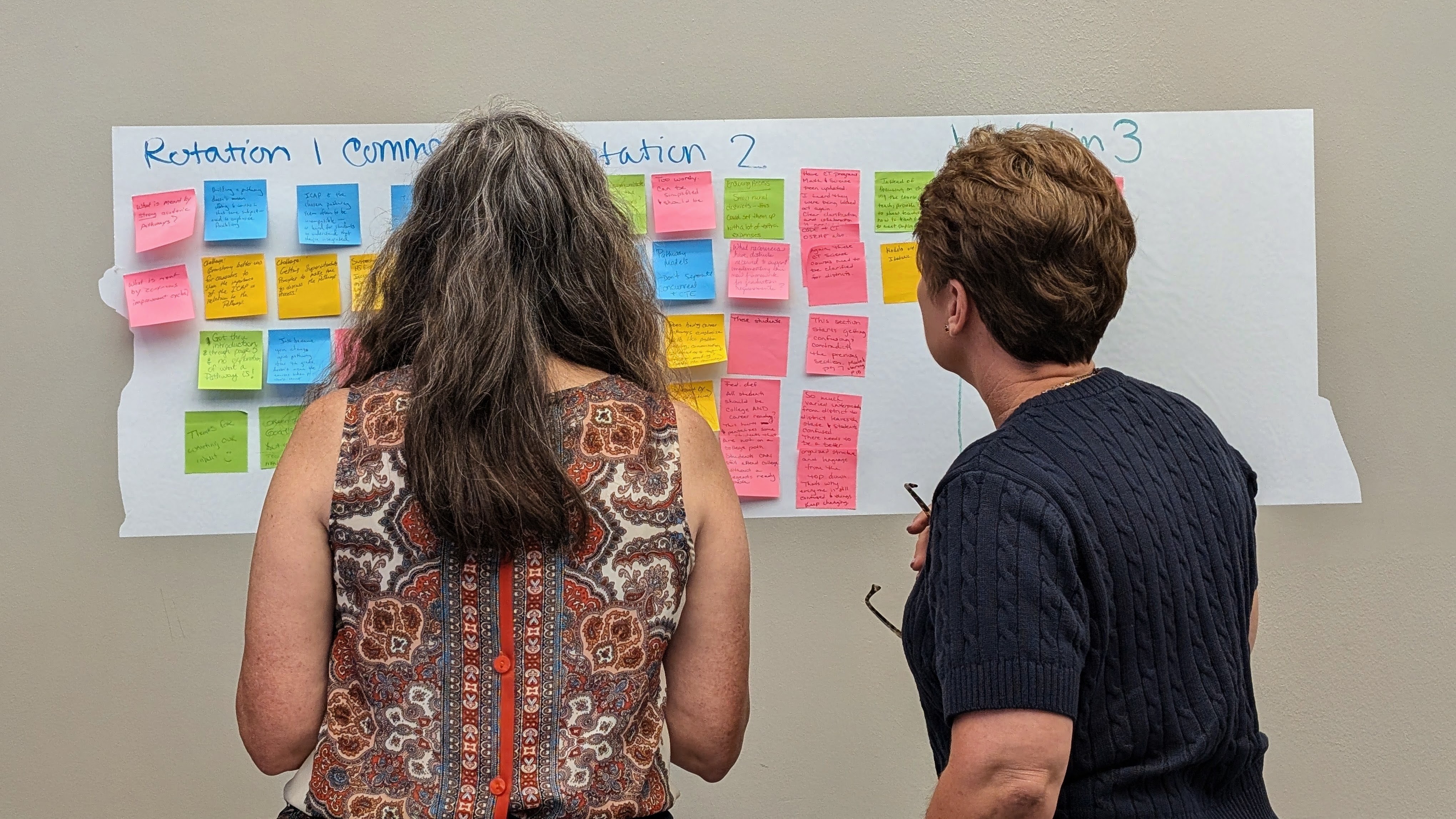
Oklahoma school and district staff review written responses on a large brainstorming chart covered with colorful sticky notes during a collaborative planning activity.
Oklahoma: Building District Support Models
Oklahoma is carving out practical feedback pathways to ensure that state supports provided to districts meet district-stated needs. New in-person statewide feedback channels, facilitated by the Southwest CC, are enabling local educational agency leaders across the state to review and provide input on draft state guidance. The guidance is ultimately intended to help all school districts in the state support their local high schools in implementing present-day Oklahoma graduation requirements.
Southwest CC is also helping Oklahoma strengthen school mental health supports by creating a statewide system where districts learn alongside and from one another. With Southwest CC's technical support, OSDE is building a Community of Practice that pairs expert training with opportunities to apply new skills, problem-solve, and get feedback from a "buddy" district. This approach ensures that every district joins a broader community doing this work while gaining practical, real-world guidance on how to implement supports within a multi-tiered system of supports framework.
As a result of proactively soliciting district viewpoints early on while building out these kinds of district supports, Oklahoma schools will receive the meaningful, actionable guidance they need to position students to meet current graduation requirements and receive wellness supports so they can focus on learning. The state has important organizing and information exchange roles to play here, and OSDE deserves credit for its service-oriented approach.
Measuring Progress to Get Better at Every Turn
Across projects like these, Southwest CC tracks district-level feedback on whether new state guidance, data, tools, and processes:
-
Enable faster local decisionmaking
-
Help solve problems districts could not solve alone
-
Support the scaling of effective practices
We expect to share project updates and to release new no-cost resources arising from this work with the field later this year.
As states across the Southwest reshape how they support districts and schools, one principle is guiding the work: provide schools and districts on the frontline with exactly what they need to succeed.